

Phang Nga Bay kayaking: your beginner’s guide
Phang Nga Bay is one of the best places in Southeast Asia to kayak, and yes, it is absolutely right for beginners. The bay’s towering limestone karsts, hidden sea caves, and enclosed lagoons called hongs create a paddling environment that is dramatic without being technically demanding. A typical trip pairs you with a guide in a sit-on-top kayak, supported by an escort longtail or speedboat throughout the day. Most Phang Nga South Sea tours include:
- Hotel transfers, lifejackets, paddle equipment, and a safety briefing
- Lunch, national park entry fees, and a qualified local guide
Qbictravel offers kayak-friendly Phang Nga itineraries with all of the above built in, making it a solid starting point if you want a hassle free day on the water.
Key takeaways
Phang Nga Bay kayaking is beginner-friendly, tide-dependent, and best experienced on a guided small-group tour with a reputable local operator.
| Point | Details |
|---|---|
| Best season | November to April offers the calmest conditions; tidal windows determine cave access year-round. |
| Tour selection | Choose a guided small-group tour with a support boat; confirm park permits, lifejackets, and guide ratios before booking. |
| Cost range | Group tours start from around US$52; private self-paddle day trips run from approximately 4,450 THB including transfers and lunch. |
| Conservation rules | Wear reef-safe sunscreen, carry out all rubbish, and never touch cave walls or coral inside the marine park. |
| Qbictravel | Offers inclusive Phang Nga South Sea tours with transfers, guide support, and equipment. |
This article is general information, not a substitute for advice from a qualified doctor. Consult a qualified healthcare professional about your own circumstances before acting on anything here.
Table of Contents
- When is the best time to go kayaking in Phang Nga Bay?
- How do you choose the right kayak tour and operator?
- What should you pack for a day on the water?
- Beginner paddling tips for caves and hongs
- What are the top kayaking spots in Phang Nga Bay?
- How do you paddle safely and protect the marine park?
- How do you get there, and what does a typical trip cost?
- Where do you stay for a multi-day kayaking trip?
- What permits and regulations apply to kayaking here?
- How should you prepare for weather hazards and emergencies?
- What fitness level do you need for kayaking in Phang Nga Bay?
- What the kayak-tour industry gets wrong about Phang Nga Bay
- Qbictravel’s Phang Nga tours put you in the right hands
- Sources
When is the best time to go kayaking in Phang Nga Bay?
The prime window runs during the dry season, when the Andaman Sea is calm, visibility is high, and tides are predictable. Crucially, tides determine whether you can enter the caves and hongs at all. Most cave tunnels require a tidal window with sufficient clearance; too high and the entrance is submerged, too low and the kayak scrapes the ceiling. Operators time departures around these windows, so a 7:30 AM pick-up in December is not arbitrary.
Morning departures also beat the crowds. By mid-afternoon, the most popular spots near James Bond Island can feel busy. If bioluminescence is your goal, evening “Hong by Starlight” trips run between June and October, when plankton activity peaks and the water glows an electric blue.
During the May–October monsoon, conditions vary sharply. The western bay around Koh Yao and the sheltered eastern channels often remain paddleable even when the open Andaman is rough. Ask your operator specifically which sites they run during that period rather than assuming the whole bay is off-limits.
Pro Tip: Before you book, ask the operator to confirm the tidal entry time for the caves on your chosen date. A reputable guide will know this immediately; hesitation is a red flag.
How do you choose the right kayak tour and operator?
The fastest rule: if you have no sea-kayaking experience, book a guided small-group tour with a support boat. Full stop. TripAdvisor reviews consistently highlight guide quality, small group sizes, and experienced local knowledge as the factors that separate a great trip from a stressful one.
Operator trust signals to confirm before you pay:
- Safety briefing included and conducted in your language
- Lifejackets provided and correctly fitted
- Guide qualifications and years of local experience
- Staff-to-guest ratio (aim for no more than 6–8 paddlers per guide)
- Insurance coverage and valid national marine park permits
Questions to ask before booking:
- Does the price include hotel transfers, park fees, lunch, and equipment?
- What is the exact itinerary and which caves/hongs are on the route?
- What is the cancellation policy if weather forces a reschedule?
- Is there a minimum age or fitness requirement?
- What kayak type is used — sit-on-top or sit-inside?
Self-paddle trips suit experienced paddlers who want to set their own pace. A private self-paddle day trip, for example, typically starts at Koh Kudu Yai and Koh Roi with an escorted longtail alongside. That format requires solid forward-stroke technique and comfort reading tidal conditions independently. For most first-timers, a fully guided option is the smarter choice. Qbictravel’s guided adventure tours cover safety briefings, local expertise, and equipment as standard.
What should you pack for a day on the water?
The non-negotiables are simple: dry bag, water bottle, sun protection, and water shoes or sandals with a heel strap. Everything else is comfort.

Your operator will supply the kayak, paddle, and lifejacket. Many also provide a small dry bag for your phone and wallet. Bring your own anyway — a second layer of waterproofing costs almost nothing and saves a ruined phone.
Clothing: Quick-dry shorts and a rash vest or lightweight long-sleeve top work best. A wide-brim hat stays on better than a cap when you’re paddling into a headwind. Reef-safe sunscreen is not optional; the marine park’s coral is close to the surface and chemical sunscreens cause measurable damage.
Small extras worth adding:
- Insect repellent (mangrove sections attract mosquitoes at low tide)
- Snorkel mask if you want to swim at lunch stops
- Waterproof phone case or action camera
- Spare cash in a zip-lock bag for any additional park fees or drinks
Pro Tip: Wear your swimwear under your clothes from the start. Changing on a longtail boat in a swell is awkward and unnecessary.
Beginner paddling tips for caves and hongs
- Sit upright and relax your grip. Tension in your hands travels up your arms and tires you out fast. Hold the paddle loosely and let your torso do the rotation.
- Use a full forward stroke. Reach forward, plant the blade fully, and pull through to your hip. Short, splashy strokes waste energy and spray your partner.
- Brace low if you feel unstable. Place the paddle flat on the water surface beside you. Sit-on-top kayaks are very stable; a low brace almost always rights a wobble before it becomes a capsize.
For cave and hong entries, follow your guide’s instructions precisely. When the ceiling drops, lean back and lie flat — your guide will tell you exactly when. Never grab the cave walls; the rock is sharp and the barnacles cut. Communicate with a thumbs-up or thumbs-down signal if you cannot speak clearly in a low tunnel.
If your kayak takes on water, stay calm and signal your guide immediately. Support boats are positioned nearby for exactly this reason. Fitness-wise, a standard day trip involves 2–4 hours of light paddling with rest stops. If you can walk comfortably for an hour, you can kayak here.
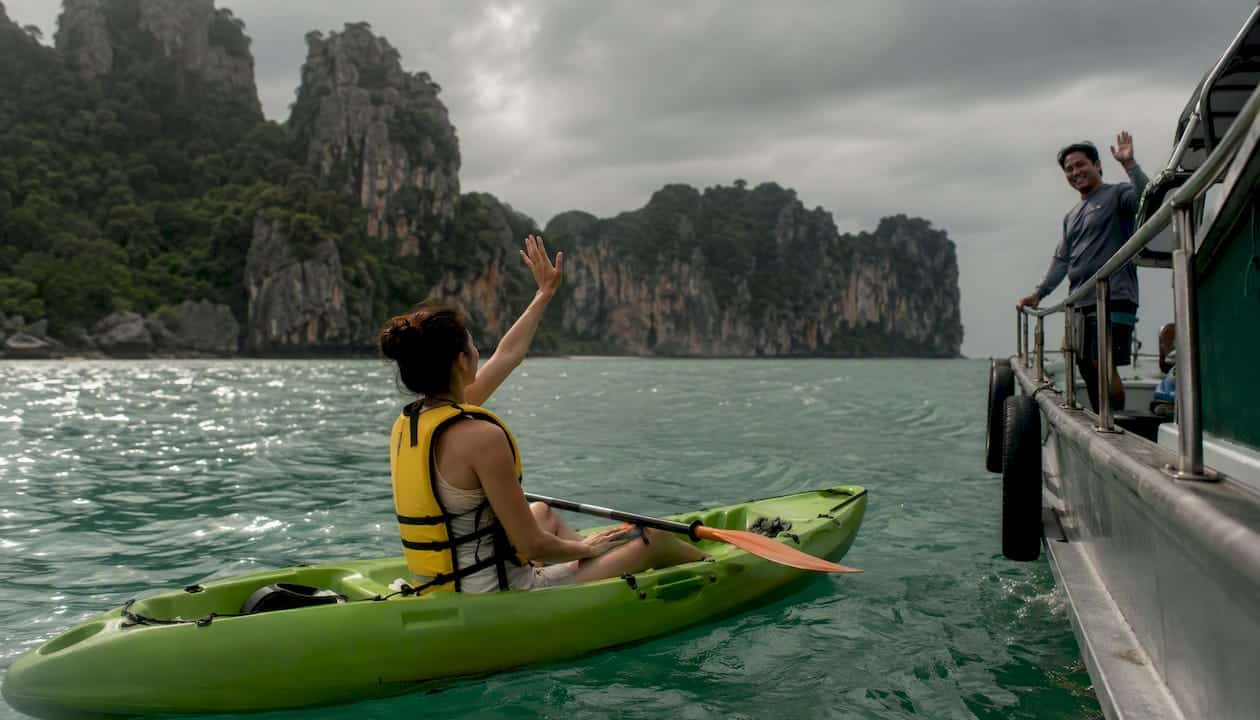
What are the top kayaking spots in Phang Nga Bay?
The bay covers roughly 400 square kilometres, so knowing where to focus matters.
- Koh Hong and Panak Island: The classic hong experience. Tidal caves lead into enclosed lagoons ringed by jungle. Panak has multiple hongs accessible in a single visit. Tide-sensitive — morning entry is usually best.
- Koh Roi: Quieter than Panak, with excellent mangrove channels and a more relaxed pace. Good for wildlife spotting, including monitor lizards and kingfishers.
- James Bond Island (Khao Phing Kan): Iconic scenery from The Man with the Golden Gun. Kayaking here means paddling around the famous pillar rock, Khao Tapu. Busy by mid-morning, so arrive early.
- Mangrove channels near Ao Phang Nga: Flat-water paddling through dense mangrove forest. No tidal cave access, but the wildlife and atmosphere are genuinely special. Suitable for all fitness levels.
- Hong by Starlight zones: Specific hongs visited after dark for bioluminescent plankton. Operated seasonally between June and October.
Tours commonly depart from Tha Don pier in Phang Nga town or Ao Por pier on Phuket’s east coast. Your operator arranges the transfer; you just need to be ready at your hotel at the stated pick-up time.
How do you paddle safely and protect the marine park?
Two rules cover the legal and safety basics: obey your guide at all times, and wear your lifejacket throughout the trip. Everything else flows from those two.
Conservation behaviours the marine park expects:
- No touching coral, cave walls, or marine life
- Keep at least two metres from wildlife, including sea eagles and monitor lizards
- Carry all rubbish back to the boat — no exceptions
- Use only reef-safe sunscreen (chemical UV filters are harmful to coral)
- No feeding fish or other animals
Tidal cave safety: Guides will refuse cave entry if the tidal window has closed or if conditions are unsafe. This is non-negotiable and is not a decision you can override. If a guide turns back, trust them — the cave will still be there on a better tide.
For emergencies on the water, your guide carries a radio and coordinates with the support boat. The nearest marine rescue contact is the Thai Maritime Enforcement Command Centre at 1196 (24-hour hotline). Save this number before you leave your hotel.
How do you get there, and what does a typical trip cost?
Most visitors travel from Phuket. The drive to Ao Por pier takes about an hour from Patong; operators often include this transfer in the package price. From Phang Nga town, Tha Don pier is about 10 minutes by taxi.
Tour listings on GetYourGuide show guided Phang Nga Bay canoe and kayak tours starting from around US$52 per person for group options. Private self-paddle day trips with transfers, equipment, lunch, and insurance are listed at around 4,450 THB per person.
| Trip type | Typical duration | Price range | Inclusions | Fitness level |
|---|---|---|---|---|
| Half-day group tour | 4–5 hours | From US$52 | Transfers, guide, equipment, lifejacket | Low |
| Full-day guided tour | 7–8 hours | 4,450 THB | Above + lunch, park fees | Low to moderate |
| Private self-paddle day | 7–8 hours | From 4,450 THB | Transfers, escort boat, lunch, insurance | Moderate |
| Overnight kayak + camp | 2 days | Varies by operator | All meals, camping gear, guide | Moderate |

Where do you stay for a multi-day kayaking trip?
For overnight and multi-day trips, Koh Yao Noi is the most practical base. The island sits in the heart of the bay, cuts your daily paddling distance significantly, and has a range of guesthouses and small resorts suited to early starts. Koh Yao Yai offers similar access with slightly more accommodation choice.
If you prefer to stay in Phuket and travel out each day, the east-coast areas of Ao Por and Bang Rong are closest to the departure piers and avoid the long cross-island drive from Patong. Budget guesthouses and mid-range hotels are available in both areas.
What permits and regulations apply to kayaking here?
Phang Nga Bay sits within Ao Phang Nga National Marine Park, administered by the Department of National Parks, Wildlife and Plant Conservation (DNP). Any kayaking within the park boundary requires a valid park entry fee, currently collected at the pier or included in your tour price. Operators must hold a licensed concession to run commercial tours inside the park.
You cannot legally launch a private kayak inside the park boundary without prior authorisation from the DNP. If you plan an independent multi-day expedition, contact the DNP Phang Nga office directly before your trip to confirm current permit requirements and restricted zones.
How should you prepare for weather hazards and emergencies?
Check the Thai Meteorological Department forecast (tmd.go.th) the evening before your trip. Look specifically for wind speed above 20 knots and wave height above 1 metre — either figure is grounds for your operator to reschedule. Reputable operators monitor these thresholds and will contact you proactively.
Lightning is the most serious acute hazard on open water. If you see a storm building, paddle immediately to the nearest sheltered shore and wait with your guide. Do not attempt to outrun a storm in a kayak.
Key emergency contacts to save:
- Thai Maritime Enforcement Command Centre: 1196
- Tourist Police: 1155
- Phang Nga Hospital: +66 76 412 034
What fitness level do you need for kayaking in Phang Nga Bay?
A standard day trip is genuinely accessible to most healthy adults. You will paddle for roughly 2–4 hours across the day, broken into short segments with rest stops at caves, hongs, and lunch. No prior kayaking experience is required.
People with lower back problems may find the seated paddling position uncomfortable after an hour. A sit-on-top kayak with a backrest helps considerably — ask your operator which kayak model they use. Pregnant travellers and anyone with a recent shoulder or wrist injury should consult a doctor before booking.
Children as young as 6 can usually join as passengers in a tandem kayak, though minimum age policies vary by operator. Confirm this at the time of booking.
What the kayak-tour industry gets wrong about Phang Nga Bay
Most tour descriptions lead with James Bond Island, and that framing does a disservice to the bay’s real appeal. The pillar rock at Khao Tapu is photogenic, but the actual paddling around it is brief and the site is crowded by 10 AM. The hongs at Panak and Koh Hong are where the experience genuinely delivers — enclosed lagoons you reach only by lying flat in a kayak through a tidal tunnel, emerging into a world that feels completely cut off from the outside. No tour description adequately prepares you for that moment.
The second thing the industry underplays is tidal timing. Many operators advertise a fixed departure time without explaining that the quality of your cave access depends entirely on whether that departure aligns with the right tidal window. A good operator builds the schedule around the tide, not the other way around. Ask the question directly before you book.
Qbictravel’s Phang Nga tours put you in the right hands
Phang Nga Bay rewards visitors who book with an operator that genuinely knows the bay’s tidal rhythms, cave systems, and wildlife spots. Qbictravel’s Phang Nga South Sea tours include hotel transfers, local guide support, and equipment as standard, with itineraries built around the sites that actually deliver on the bay’s promise.

If you want to add more adventure to your Phuket trip, Qbictravel’s full tours range covers everything from ATV rides to speedboat island-hopping. Book online or via WhatsApp for flexible, last-minute availability.
Sources
- The best Phang Nga Bay Canoe & kayak tours 2026 – Free cancellation | GetYourGuide
- Andaman Sea Kayaks – Phuket – Tripadvisor


